
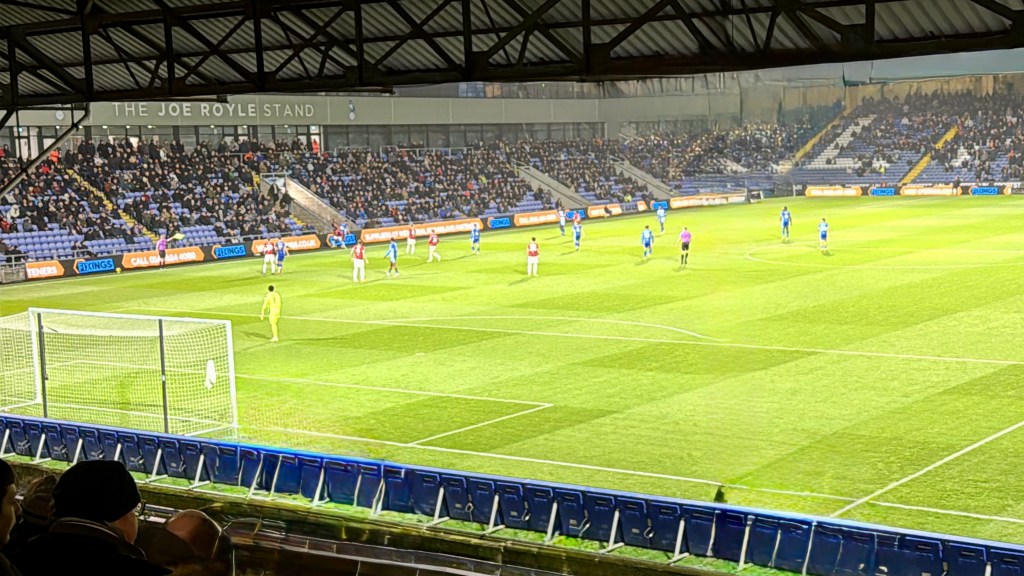
Top of the Table, Looking Sideways at It
There is a particular feeling that comes with watching a team sit top of the table while knowing, deep down, that this is not quite how dominance is usually supposed to look (those at Oldham will attest). Walsall are there now, first in League Two (again) after 20 games, blinking politely from the summit. It is real. It is earned. And it is also, unmistakably, familiar.
When the Supporters’ Trust issued its end-of-season statement after Wembley in May, it did not do so in anger or hysteria. The language was careful. The intent constructive. Progress was acknowledged. But the point was made clearly enough: the collapse was not cosmetic. A 15-point lead dissolved into a 13-game winless run not because of bad luck or fine margins, but because something underneath had quietly given way.
That context matters now, precisely because things are going so well. Credit is due to Mat Sadler and this season’s group. That is not in doubt here.
A team that arrives, not one that settles
Look at the numbers and they tell a story that will feel instantly recognisable to anyone who has watched Sadlerball this season. Possession hovers at around 38% — the sort of figure usually associated with teams clinging on rather than cruising. There is no attempt here to smother opponents with the ball, to pass them into submission, to turn matches into long, soporific exercises in control. In an age of sideways recycling and earnest xG diagrams, it is oddly refreshing.
And yet. And yet.
From that modest share of the ball come around 23 shots per game, 15 of them in the box, 40 touches in the opposition area, and more than three big chances created each match. Walsall do not so much dominate games as appear suddenly in them, like your phone alarm going off on a Sunday — completely unexpected and immediately unpleasant for the person next to you. Attacks arrive in short, sharp episodes. The aim is not control, but incision.
It worked last season too — until it didn’t.
The thin line between efficiency and exposure
There is a danger, when a team sits top of the league, of assuming that questions have been answered rather than merely deferred. But the numbers carry their own small warning label.
Walsall also miss close to two big chances per game. That is not a criticism; it is a measure of the efficiency this model requires. When you don’t have the ball for long spells, you don’t get an endless supply of opportunities. You get moments. And someone has to turn those moments into goals.
Which brings us, inevitably, to Daniel Kanu.
This is not about star power or sentiment. It is structural. Player data shows goals are narrowly concentrated, with Kanu averaging around 0.6–0.7 goals per 90 and scoring in over ten separate matches, often delivering a single, decisive goal rather than a brace-laden afternoon. Elsewhere, contributions arrive in flickers — the odd midfielder popping up, a centre-back nodding one in, long stretches of zeroes punctuated by set pieces. Remove that finishing efficiency and the whole apparatus begins to creak, because there is no surplus of goals waiting elsewhere to absorb the loss.
Supporters know this story already. Last season, when Nathan Lowe went back to Stoke, the system remained in place but the outcomes changed. The Trust flagged this not as misfortune, but as a planning risk. That risk has not been designed out; it has simply been managed — well, and thankfully — so far.
Living without the ball
There is another familiar echo in the numbers. Walsall average well over 60 clearances per match. Fouls are frequent. Cards accumulate. The goalkeeper is busy, making five or six saves a game. This is not passive football, but it is reactive — a style that demands constant vigilance and leaves little room for error.
When the goals come, it looks purposeful. When they don’t, we all panic slightly, because we are Walsall fans and this is what we do.
Again, this was visible last season. Again, it is visible now.
What being top does — and doesn’t — mean
So yes, it is both mildly surprising and oddly unsurprising to see Walsall at the top of the table again. Not because they haven’t earned it, but because this kind of football rarely buys long-term comfort. It is a high-wire act, performed with impressive balance — but still a high-wire act.
The Trust’s statement in May did not argue that progress was illusory. It argued that progress without reinforcement is dangerous. That remains true.
January, once more, in plain sight
Which brings us to January, every Walsall fan’s worst nightmare, standing ominously on the near horizon. For the fourth year running, Walsall appear to have fallen in love with someone else’s striker.
If Daniel Kanu is recalled and not replaced with comparable quality, this is not simply a loss of goals. It is the removal of a load-bearing beam. Low possession will cease to be efficient. Missed chances stop being tolerable. Defensive pressure becomes onerous.
What complicates this — and what makes the risk sharper — is the shape of the midfield behind it.
Qualitatively, this is not a midfield being bypassed or overrun for the full 90 minutes. The game does not appear to pass over their heads for the entire game. The data supports that impression. Walsall complete close to 700 passes per match across the side, win interceptions and tackles at high volume, and retain enough structure to keep games competitive despite long spells without the ball. This is a functional, midfield — one that screens, works hard and shows plenty of endeavour.
But it is would be stretch to say it is a creative hub.
Last season, in the first half, Ryan Stirk became something of the League Two Pirlo, operating as a deep-lying playmaker, dropping in, linking phases, offering an alternative route when direct play stalled. It gave the team another way of progressing the ball, another rhythm. When opposition sides began man-marking, current to his loss of form (along with many of his teammates in the second half of the season), that outlet disappeared — and with it, tactical elasticity.
That profile has not been replaced.
The current midfield does not lack intelligence or effort; it lacks a player who can change the tempo from within, who can slow the game down on demand, or accelerate it deliberately rather than accidentally. As a result, for the class of 2026 the burden shifts forward. Goals must arrive on schedule. Finishing must remain sharp. The striker must not just score — he must resolve matches.
Remove Kanu without replacing either his output or the connective tissue behind him, and the system has no shock absorber. Everything becomes louder, faster, and more fragile.
We have seen how quickly that descent can begin.
A plea to Trivela
For now, Walsall are top. It is a position to enjoy, not to downplay. The work is real. The execution is sharp. The football, for all its tension, is effective. Oldham away was an awful game of football but the bond between the players and the fans at the end was special.
But — and Trivela, we hope you are listening — context still matters. Last season’s collapse did not come out of nowhere. It came from a system stretched just a little too far. One assumes the newly discovered 50p charge added for printing tickets on. match day is part of a long-term savings plan, hopefully culminating in the arrival of a proven League Two goalscorer sometime in January.
Time will tell us whether that lesson has been learned — or merely postponed once again.
Discover more from Walsall Football Supporters' Trust
Subscribe to get the latest posts sent to your email.
 Walsall Football Supporters' Trust
Agree with the complete narrative there.
LikeLike
A thoughtful piece. A number of good points made , in particular the need to make the most of our chances.
The Trivela model doesn’t include spending money on transfers, rather the opposite, so we can see that the club researches potential assets which is fine but always subject to availability and timing. This is where we have fallen short in the past and I hope history does not repeat itself.
LikeLike